1.The mission of the project
To create a modern Russian passenger vessel of a new generation, which will become an effective alternative to existing river and coastal passenger boats.
The catamaran is designed for operation:
- urban waterways;
- river public transport;
- tourist routes;
- pleasure flights;
- high-speed transportation between the islands;
- coastal sea routes;
- corporate transportation;
- transportation for resort areas.
The project is designed for intensive daily operation with minimal operating costs and a high level of reliability.
The main objective of the project is to make a modern passenger catamaran as accessible as possible for production and operation.
2. The idea of NALIM (Next-generation Adaptive Low-wake Industrial Multihull)
Burbot is one of the most unusual river fish. It feels great in strong currents, cold water and difficult conditions.
These qualities formed the basis of the project's philosophy.
Basic principles:
**Simplicity of construction**Each element of the building is designed from the perspective of production efficiency.
Engineering minimalism
A minimum of decorative elements.
Maximum functionality.
Reliability
The vessel has to operate daily for many years.
Cost-effectiveness
The life cycle cost is more important than the purchase cost.
Modernity
NALIM is not trying to look futuristic.
It looks like a modern engineering machine.
3. General concept and design
The design follows the corporate philosophy of RenderWorks Industrial Design.
The main idea is to create an appearance that simultaneously:
- modern;
- technological;
- recognizable;
- easy to produce.
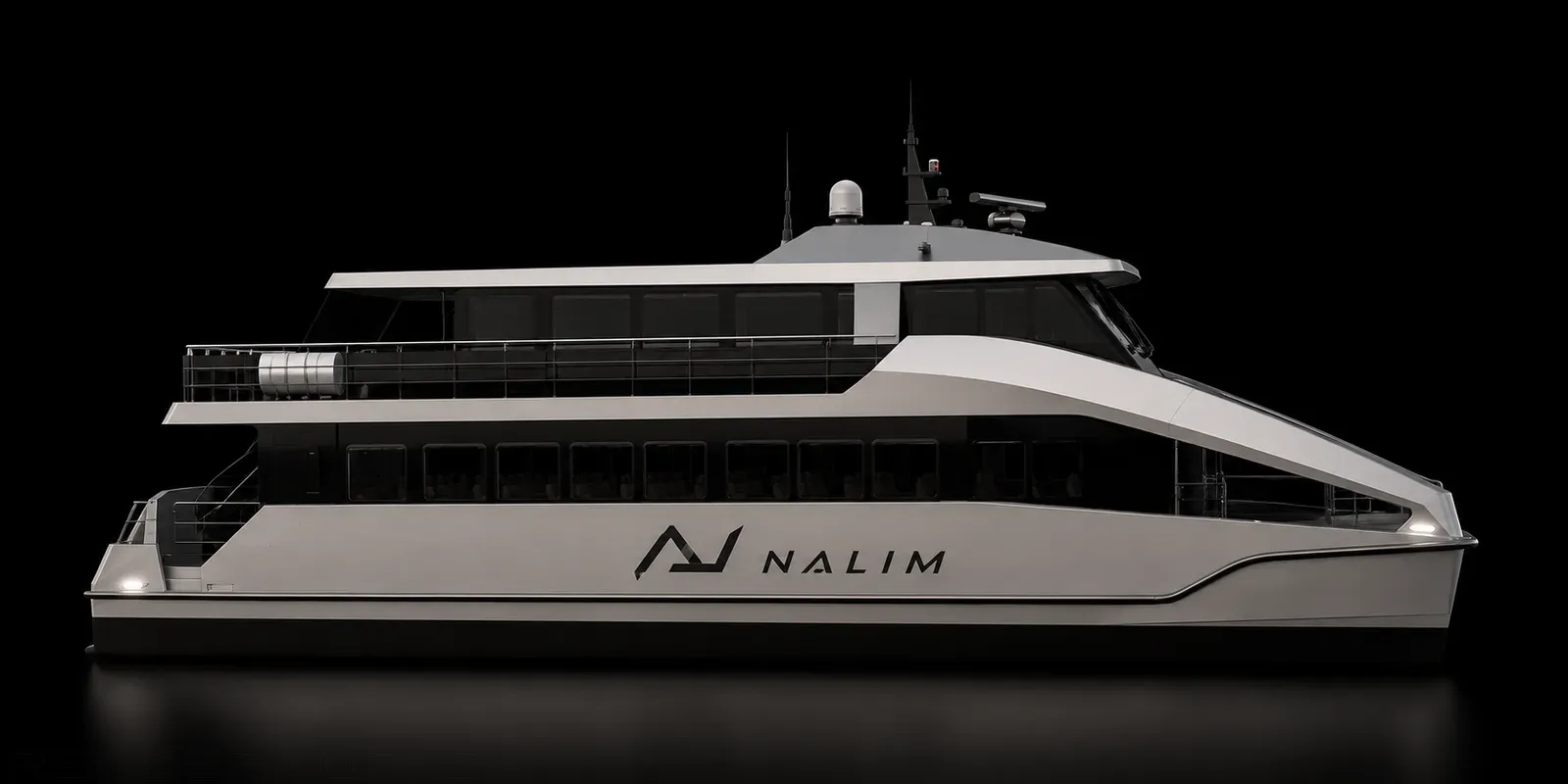
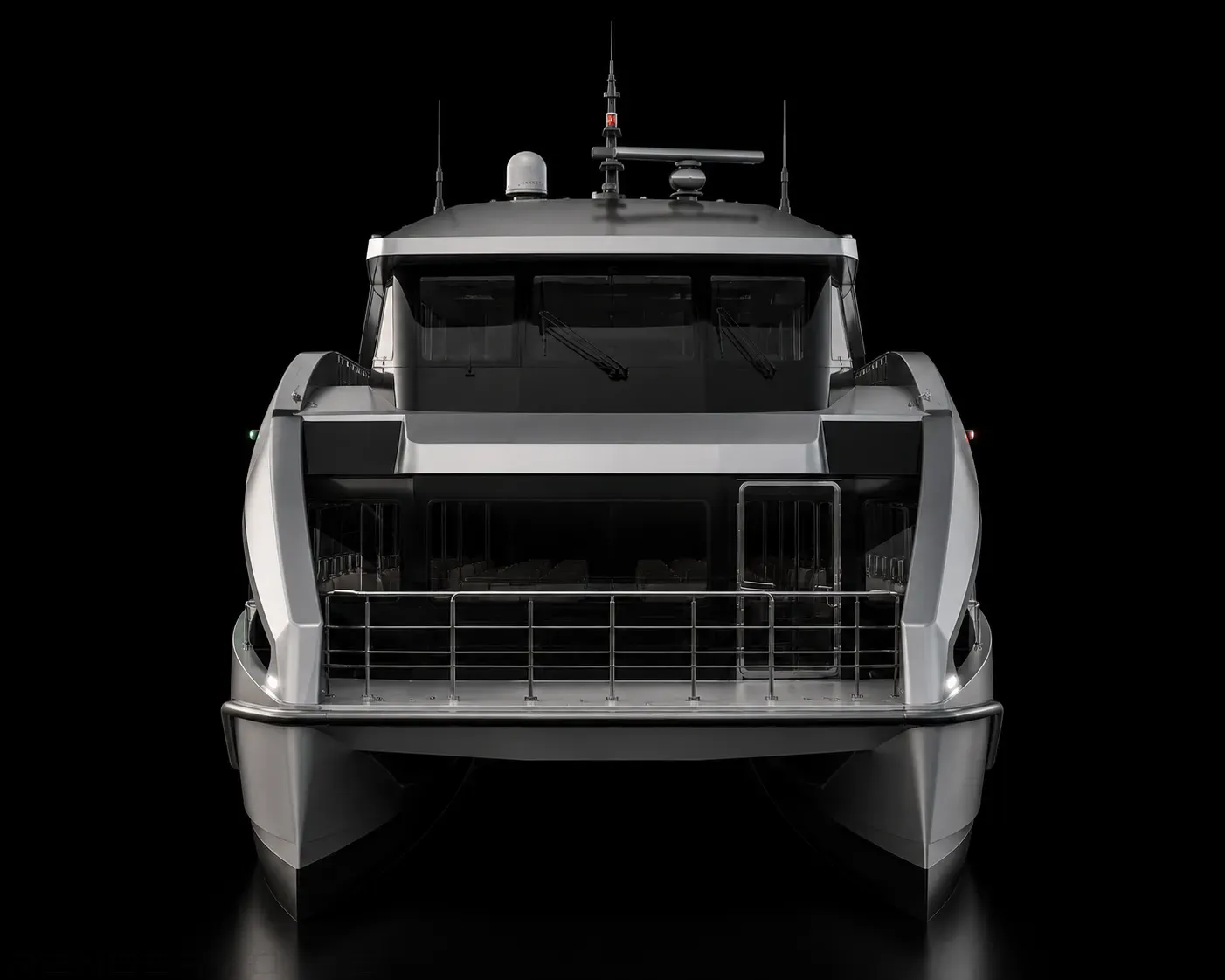
Housing architecture
The catamaran has:
- two displacement hulls;
- wide central bridge;
- spacious passenger cabin;
- open aft deck;
- open upper promenade deck;
- panoramic glazing;
- high visibility.
The main feature is the large diagonal side elements that form a recognizable silhouette and at the same time work as power structures.
Case design
The case is made mainly of:
- flat sheets;
- single-curved panels;
- large modular elements.
There are practically no complex double surfaces. This dramatically reduces the cost of production.
4. Engineering solutions
The project is initially created as a fully digital engineering system.
Modern technologies are used in the development process.:
- CAD;
- CAM;
- CAE;
- digital twins;
- CFD analysis;
- finite Element Analysis (FEA);
- parametric design;
- automatic production preparation.
Production technologies
The design is fully oriented towards modern production facilities:
- laser cutting;
- waterjet cutting;
- plasma cutting;
- CNC sheet bending;
- laser welding;
- robotic welding;
- modular assembly of sections;
- digital geometry control.
This approach can significantly reduce the number of manual operations and ensure consistently high quality products.
Construction
Main Features:
- full aluminum body;
- the power set is optimized by the FEA method;
- modular architecture;
- unified panels;
- minimum number of unique parts;
- convenient access to all units;
- the possibility of mass production.
5. Key advantages over existing machines
Ease of manufacture
Most modern passenger catamarans have complex spatial surfaces.
NALIM is specially designed for industrial production.
Highly technological
All panels are easily mass-produced.
Minimum manual adjustment.
Quick assembly
The case is assembled from large modules.
This reduces the production time.
Low cost of ownership
- less labor-intensive repairs;
- lower cost of spare parts;
- high maintainability;
- long-lasting resource.
Modern design
Despite its simple design, the catamaran looks modern and prestigious.
Universal platform
One design can be used to create a large family of vessels.
6. General technical specifications
| Parameter | Value |
|---|---|
| Type | Passenger Catamaran |
| Hull material | Marine aluminum alloy |
| Length | 18-22 m |
| Width | 6.5–8 m |
| Draft | 0.8–1.2 m |
| Capacity | up to 100 passengers |
| The crew | 2-4 people |
| Economic speed | 18-22 knots |
| Maximum speed | 25-30 knots |
| Cruising range | up to 500 km |
| Swimming area | Rivers, lakes, reservoirs, coastal marine areas |
| Type of power plant | Diesel, diesel-electric or fully electric |
| Thrusters | Propellers, water cannons or azimuth columns |
| Construction | Catamaran |
| Decks | 2 |
| Upper deck | Walking area |
| Accessibility | The possibility of execution for passengers with limited mobility |
| Service life | More than 30 years |
| Design method | Fully digital (CAD/CAM/CAE) |
7. Family Architecture
The NALIM platform is designed as a single modular line:
- NALIM CITY - City water bus.
- NALIM TOUR is a tourist pleasure catamaran.
- NALIM EXPRESS is a high-speed passenger catamaran.
- NALIM VIP is a premium version for corporate transportation.
- NALIM RIVER - Version for inland waterways.
- NALIM SEA - Coastal marine modification.
- NALIM ELECTRO is a fully electric version.
- NALIM HYBRID is a hybrid power plant.
- NALIM RESCUE is a search and rescue catamaran.
- NALIM PATROL - Patrol performance for government services.
- NALIM CARGO - Cargo and passenger modification.
Upgrade options
The platform provides the opportunity to:
- body length changes;
- increased passenger capacity;
- installation of various power plants;
- replacement of propellers;
- integration of new navigation systems;
- installation of autonomous control systems;
- the transition to hydrogen power plants in the future;
- applications of composite elements of the superstructure.
8. Project Prospects
NALIM is not just a new passenger catamaran, but an example of a modern engineering approach to ship design.
The project is initially created on a new technological base combining digital design (CAD/CAM/CAE), engineering modeling, automated pre-production and modern manufacturing methods: laser and waterjet cutting, robotic and laser welding, CNC machines, modular assembly and digital quality control.
This approach provides a number of advantages over traditional shipbuilding methods.:
- reducing the time required to develop and bring a product to market;
- reduction of production costs;
- improved manufacturing accuracy;
- reducing the number of manual operations;
- higher reliability of the design;
- easy to repair and upgrade;
- reducing the cost of operation throughout the entire life cycle;
- the ability to quickly scale mass production.
NALIM demonstrates the transition from traditional shipbuilding to modern digital engineering, where efficiency is determined not by the complexity of the design, but by the quality of engineering solutions. Thanks to its modular architecture, technologically advanced hull and modern design, the platform has great potential to create a whole family of next-generation passenger ships that meet the requirements of the coming decades.