1. The mission of the project
BOBR was created as a universal compact transport platform of a new generation for operation in the most difficult natural conditions.
The main objective of the project is to provide specialists with the most reliable and most technologically advanced and easy—to-operate all-terrain vehicle capable of replacing several types of equipment at once.
The machine is designed to work:
- geologists;
- oil workers;
- gas workers;
- power engineers;
- foresters;
- ecological expeditions;
- rescue services;
- hunting farms;
- scientific expeditions;
- travel operators;
- private owners.
Basic operating conditions:
- deep snow;
- swamps;
- tundra;
- forest taiga;
- swampy lakes;
- rivers;
- sandy soils;
- rocky areas;
- lack of roads;
- temperature from -50°C to +50°C.
The main principle of the project —
Get to places where ordinary vehicles can't go.
2. The idea of the BOBR project
Beaver is one of nature's best engineers.
He builds complex structures using extremely simple means, efficiently using available materials. This principle is the basis of the project.
The BOBR project was built around several ideas:
Simplicity
Each part must perform a specific function.
Reliability
A minimum of complex elements.
Maximum resource.
Engineering rationality
The structure is designed not for the sake of appearance, but for the sake of efficiency.
Passability
The car must remain mobile where most cars stop moving.
Accessibility
BOBR should be much simpler and cheaper to manufacture compared to existing analogues without loss of functionality.
3. General concept and design
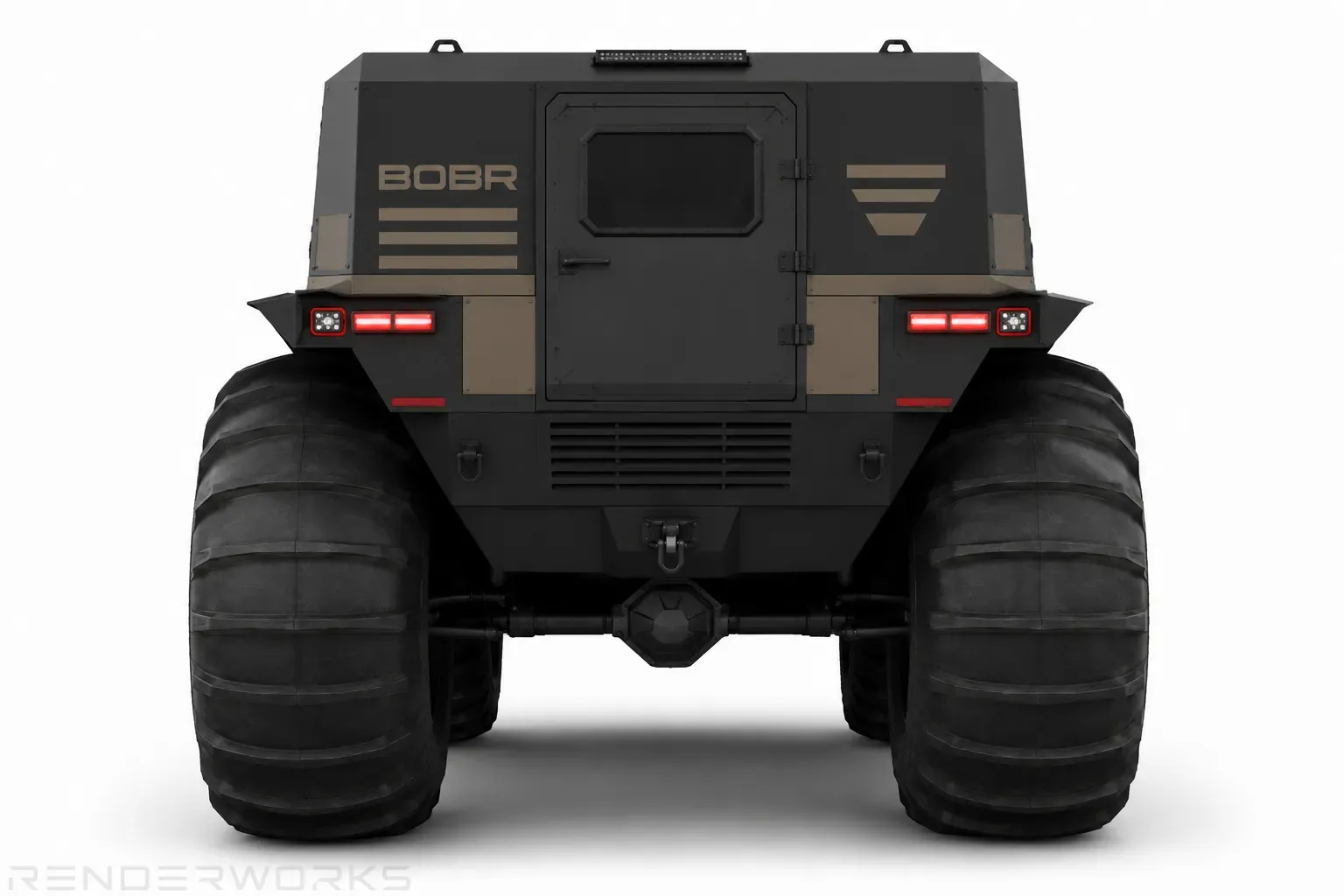
The exterior of BOBR is based on modern industrial geometry.
Main Features:
- maximum compact size;
- short overhangs;
- large entrance and exit angles;
- high visibility;
- completely flat panels;
- minimum of complex surfaces;
- lack of decorative elements;
- modern LED optics;
- expressive "muzzle" resembling a beaver's head;
- wide body with small length.
The entire exterior geometry is designed for:
- laser cutting;
- bending of sheet metal;
- serial production;
- minimum number of unique parts.
Most of the body elements have a simple flat shape.
This significantly reduces the cost of production and repair. The modern, concise BOBR logo highlights the engineering nature of the machine without using an animal image.
4. Engineering solutions
BOBR is being developed as a modern engineering platform, not as an upgrade to existing machines.
Basic Design Principles RenderWorks Industrial Design::
Digital development
The entire machine is created in a single CAD system.
Each item is digitally verified:
- kinematics;
- durability;
- mass;
- center of gravity;
- adaptability of production.
Design for Manufacturing (DFM)
The structure is initially designed for mass production.
Minimized:
- number of details;
- number of welded joints;
- the number of unique components.
Design for Maintenance (DFMA)
All major units have quick access.
It is possible to replace components directly in the field.
Sealed housing
The fully sealed lower part of the case ensures:
- confident buoyancy;
- high structural rigidity;
- protection of aggregates;
- longer service life.
Modular architecture
Almost all nodes are unified.
Replaceable modules are used:
- the engine;
- transmission;
- suspension;
- steering control;
- electrical equipment;
- interior.
Highly technological
Used:
- laser cutting;
- flexible;
- robotic welding;
- powder coating;
- modern polymer materials.
Mass optimization
The structure is designed according to the principle: ** maximum strength with minimum weight.**
5. Key advantages
Compared to existing machines of the same class, BOBR has several advantages.
More modern industrial design
Minimalistic appearance without outdated solutions.
More compact dimensions
Easier transportation. Easier storage. Higher maneuverability.
Lighter body
Improved buoyancy. Lower fuel consumption.
More technological production
Cost reduction.
Higher maintainability
Minimum of special details.
Higher tightness
Best performance when moving on water.
Modern digital engineering
Design using CAD/CAE.
High unification
Simplify maintenance.
Increased reliability
Fewer details means fewer potential failures.
6. General technical Specifications
| Parameter | Value |
|---|---|
| Wheel formula | 4×4 |
| Type | Floating all-terrain vehicle |
| Capacity | 2-4 people |
| Load capacity | 500-800 kg |
| Gross weight | 1800-2500 kg |
| Curb weight | 1200-1700 kg |
| Engine | petrol or diesel engine |
| Power | 80-150 hp. |
| Transmission box | automatic / variator |
| Maximum speed | up to 70 km/h |
| Water speed | 5-8 km/h |
| Power reserve | 500-800 km |
| Ground pressure | less than 0.12 kg/cm2 |
| Clearance | 550-700 mm |
| Tire size | Ultra-low pressure |
| Operating temperature | -50...+50°C |
| Housing material | high-strength steel / aluminum panels |
| Body type | fully sealed |
| Winch | option |
| Electrical system | 24 V |
| LED lighting | standard |
| Swimming capability | Yes |
7. Possible upgrades
- tire pumping system;
- independent suspension;
- electric drive;
- independent heater;
- solar panels;
- unmanned control;
- satellite communication;
- thermal imaging system;
- modular cargo platforms;
- power safety frame;
- various cab and body options.
8. BOBR Platform
BOBR is a modern look at a compact floating all—terrain vehicle, created using current engineering approaches and focused on mass production. The project combines a concise industrial design, a fully sealed enclosure, high cross-country capability and modular architecture, providing versatility for a wide variety of applications.
Due to digital design, component unification, simple panel geometry and design optimization, BOBR is able to offer a higher level of manufacturability, maintainability and cost-effectiveness compared to many existing analogues. This is not just another all-terrain vehicle, but an engineering platform of a new generation, ready for development into a full-fledged family of specialized machines for operation in the harshest natural conditions.