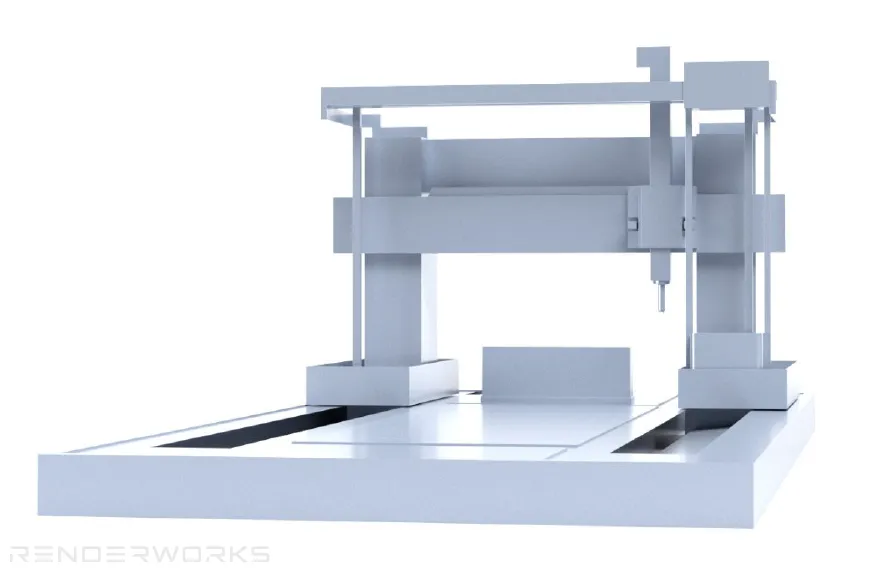
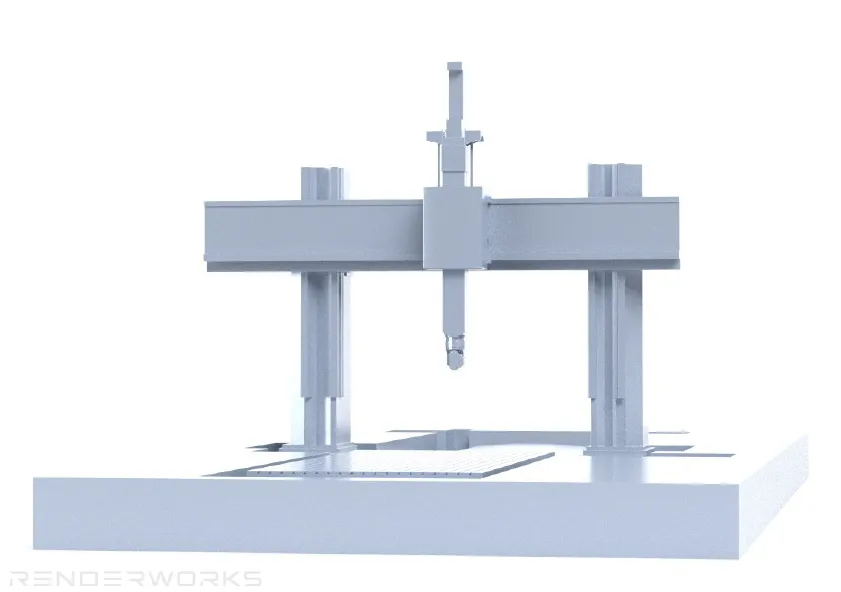
One of the most technologically challenging areas of our studio is the creation of digital counterparts of CNC metalworking machines and machining centers for the SIEMENS NX CAM system.
This is no longer a visualization of equipment, but the development of a full-fledged engineering model that completely repeats the work of a real machine: its kinematics, axis constraints, coordinate system, tooling, control system, and behavior during part processing.
Such projects make it possible to transfer the manufacturing process to a virtual environment and fully test the control program before launching the equipment.
That is why we are trusted to create digital doubles by large machine-building enterprises and manufacturing companies, where the cost of an error can be in the tens or hundreds of thousands of rubles.
What is a digital double
Unlike the usual 3D model, the digital twin is a full-fledged mathematical model of the equipment.
During operation, the following are reproduced:
- kinematics of all axes of the machine;
- real movement restrictions;
- coordinate systems;
- tool shops;
- spindle nodes;
- tool assemblies;
- adaptations;
- tables, cubicles, jacks, clamps;
- blank;
- cutting tool;
- the logic of operation of a specific CNC system.
The images show both the digital machine model itself and the process of checking the control program directly in the SIEMENS NX CAM environment. During the simulation, the movement of all components of the equipment, the position of the tool, the material to be removed, the processing trajectory and the current parameters of the control program are displayed.
In fact, the engineer gets the opportunity to observe the operation of the machine as if it were already installed in the workshop.
Virtual verification of control programs
After the digital twin is built, the virtual processing of the part is performed.
During the simulation, the system automatically checks:
- tool collisions with the machine;
- tool collisions with tooling;
- spindle and mandrel collisions;
- cuts of the part;
- leaving the tool outside the working area;
- overrun of the axles;
- tool change errors;
- correctness of the processing sequence;
- the time of each operation.
Upon completion of the inspection, a detailed report is generated containing information about the tool used, cutting modes, processing time, and all detected warnings or errors.
This approach eliminates most of the problems even before the program is transferred to production.
What the company gets
The use of digital doubles can significantly improve the efficiency of pre-production.
The main advantages of the technology:
- almost complete exclusion of trial runs on the equipment;
- reduction of the preparation time for management programs;
- reducing the risk of damage to expensive tools;
- prevention of equipment collisions;
- reducing the number of marriages;
- more accurate planning of processing time;
- increased loading of the machine park;
- the ability to safely test new processing technologies.
For a modern machine-building enterprise, the digital twin becomes part of a unified digital production environment.
Requirements for a digital twin
Creating a digital twin requires significantly more work than conventional modeling.
When developing, it is necessary to take into account:
- the design of a specific machine;
- kinematic scheme of the equipment;
- features of the CNC system;
- used postprocessors;
- tool shops;
- technological equipment;
- the applied systems of fastening of details;
- cutting tool libraries;
- real hardware parameters.
That is why each project is created individually for a specific machine model and a specific production.
The stages of creating a digital double
The work is carried out in stages.
1. Equipment inspection
- study of machine tool design;
- kinematic scheme analysis;
- inspection of the equipment and tools used.
2. Analysis of the company's digital environment
- study of CAD/CAM systems used;
- analysis of existing tool libraries;
- checking postprocessors;
- analysis of existing technological documentation.
3. Study of design documentation
- equipment passports;
- kinematic schemes;
- technical specifications;
- parameters of the CNC system.
4. Creating a digital double
- equipment modeling;
- kinematics programming;
- creation of digital equipment;
- creation of tool assemblies;
- setting up the coordinate system.
5. Integration into SIEMENS NX CAM
- connecting a digital twin;
- setting up libraries;
- testing the operation of the model.
6. Verification of control programs
- creation of test operations;
- virtual processing;
- collision checking;
- analysis of the results;
- generation of reports.
7. Commissioning
- training of specialists;
- preparation of operational documentation;
- project support.
Why is this important
The cost of a modern machining center can amount to tens of millions of rubles, and the cost of an error when a tool collides with a machine tool often exceeds the cost of the entire project to create a digital twin.
Therefore, the largest manufacturing enterprises are switching to Virtual Licensing technology, when the control program is first fully tested in a virtual environment, and only after successful verification is transferred to real equipment.
This reduces pre-production time, reduces downtime, and makes the processing process much safer and more predictable.
RENDERWORKS Competencies
Our studio has practical experience in developing digital equipment doubles in the SIEMENS NX CAM environment. We create not only geometric models, but also program their kinematics, set up tool libraries, create digital tooling models, and support the production implementation process.
If your company needs to reduce the time required to prepare control programs, reduce the likelihood of errors in machining parts, and increase the efficiency of using CNC equipment, RENDERWORKS specialists are ready to develop a digital twin of your machine and integrate it into the existing technological chain.